

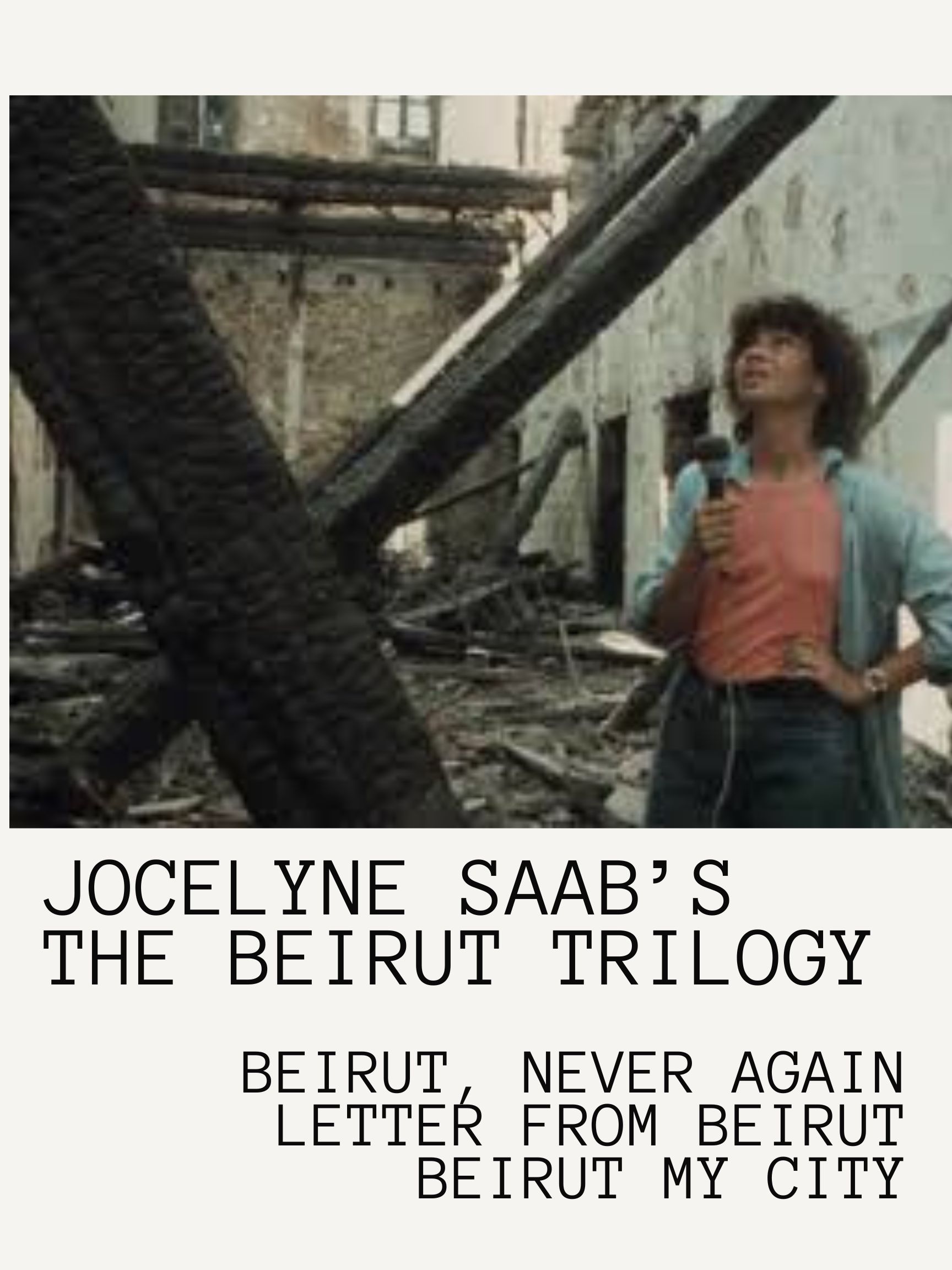
The Beirut Trilogy
- Sun, Apr 19
Midnite weekend screenings happen on Friday & Saturday nights,. so please be sure to arrive on Friday and/or Saturday night by 11:45pm for seating and the screening will start after midnight.
Director: Jocelyne Saab Run Time: 118 min. Format: DCP
From Film at Lincoln Center:
Lyrical and uncompromising, the films of Jocelyne Saab (1948-2019) are at once landmark works of Lebanese cinema and masterpieces of the essay film form. The poetic voiceovers of her movies recall Chris Marker, and her fragmented, diaristic images are reminiscent of Jonas Mekas. But Saab’s poetic vision, and her intimate interactions with the displaced, the exiled, and the voiceless, mark her films as uniquely her own. Trained as a radio and television journalist, Saab turned her attention to nonfiction films in the wake of the Lebanese Civil War. Her epic, impressionistic trilogy of documentaries about Beirut that followed captures a city at once wounded, mournful, and bristling with life and energy, chronicling a moment at which “a kind of bitter poetry has replaced the carelessness of the past.”
Beirut, Never Again
France, 1976, 35m
French with English subtitles
Gunfire and song mix with a poetic voiceover written by the Lebanese writer and painter Etel Adnan in what would become the first entry in Saab’s “Beirut trilogy,” which searches for traces of life amid the bombed-out buildings and errant fires of a ghost city, where even the children have become soldiers, looters, and scavengers.
Letter from Beirut
France, 1978, 48m
French with English subtitles
Dreamlike, melancholy, and cautiously hopeful, this epistolary film finds Saab returning to a Beirut that has irrevocably changed, where she wanders the streets, rides buses, chats with refugees and peacekeepers, and reflects on the war’s toll during a brief moment of peace.
Beirut, My City
France, 1982, 35m
French with English subtitles
Considered by Saab to be her most important film, Beirut, My City returns Saab and her collaborator, the playwright and director Roger Assaf, to the shell of her former home following Israel’s 1982 invasion, finding small glimmers of hope in the chaos of refugee camps and the rubble of decimated neighborhoods.